Well today and this week is turning out to be quite the day for web-tech related news. Perhaps calling it the web apocalypse is a bit much, but it certainly seems the past month or two has been filled with crisis, huge news stories, and other signs the web is growing ever more powerful and also struggling to maintain stability (oh, wait, the web will never be stable, it’s constantly evolving).
Twitter is Down: Denial of Service
Twitter joins 4chan, reddit, and the Gawker Media sites as the latest to fall victim to a Denial of Service attacks. What is going on lately with these DDoS attacks? A few weeks back, a large number of internet users experienced a web-wide slowdown due to a DDoS attack against some of the biggest U.S. sites, and since then it seems there’s been a new attack every few days against a huge site. With Twitter going down today, web geeks panicked as they had little recourse to send out messages about ___ being down.
As of 1 PM, Twitter is back up and functioning normally, but will they be attacked again? Who will be the next target? Is one group responsible for all these recent attacks or is there a copycat effect going on?
Facebook Struggles as Twitter Falls
Of course, the first place the majority of Twitter users would flock to would be Facebook. Unfortuanetly for them, Facebook too was having network issues today. As of 1 PM, I’m receiving errors at Facebook.
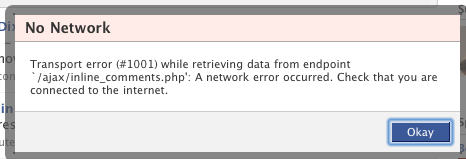
Facebook's Network Struggles
Die IE6, Die IE6, Die
CNN reports that the movement to kill off Internet Explorer 6 has been renewed with vigor. They’re not the first to break the story but are the biggest mainstream media outlet to report on it. Back in July a few major web companies begin announcing they are dropping full support for Internet Explorer 6. Mashable reported on the trend as well as listing a plethora of reasons why IE6 should be killed off and forgotten. Since then, the kill IE6 movement has been snowballing, reaching new heights today with the CNN article.
But, at the end of the day, most IE6 users are stuck in the antiquated browser because the corporation they work for has too many applications developed in-house that break outside of IE6. I don’t think anyone out there is willfully using IE6 because they think it rocks. Rather, they’re stuck using it.

Warning: Internet Explorer 6 is in your PC!
Still, going back to my corporate days I remember that it wasn’t exactly difficult to get Firefox running alongside IE6. Even Microsoft wants users to upgrade from IE6, but since it’s not easy to get fully working, fully supported versions of IE6 and IE8 running on the same desktop (I have such a setup for testing purposes, but it isn’t bug-free) we’ll likely continue to see corporate IT departments holding back the web by keeping IE6 on the corporate desktop.
I’m all for this movement, but it’ll take more than Youtube, Digg or Facebook not working properly to kill off IE6. It’ll take a truly huge site that corporate users must have access to, something like Google. Until then, web developers have three choices, ignore IE6 users, create a skeleton version of the site for IE6, or handicap their overall site by ensuring it works in all browsers by default.
Paying for Online News
Last but not least, Rupert Murdoch announced that he’ll be switching all News Corp. web-sites over to a paid format. The key quote from the announcement:
“Quality journalism is not cheap, and an industry that gives away its content is simply cannibalizing its ability to produce good reporting,”
Does that mean the Fox News web-site will remain free?
Seriously, paying for news isn’t a terrible thing. It’s unlikely to work, but if the quality is truly there, meaning news is reported pro-actively instead of re-actively, and has investigation behind it and doesn’t simply regurgitate press releases, then people will pay. How many is the real question.
Thanks to the Rich Man for the photo of the four horses.

Being a computer engineer I can imagine that the developers over at twitter were freaking the Eff out. Although there is a part of me that half gets a little giddy inside thinking about how much traffic you would have to send to take down a site like twitter. I’m sure 10’s of thousands of computers must have been sending requests all at the same time. O and I seriously doubt paying for content is ever going to catch on. I just don’t think people are ever going to put up money for something that they can get elsewhere online for free. If all of them did it at the exact same time then maybe it would work,
Yeah, I bet yesterday was not an easy day for the Twitter server admins. When you consider that during normal usage, Twitter is firing out tons of requests it must have taken an epic amount of zombie requests to take it down. I wonder if they targeted a high volume account so that it would piggyback off some of the regular + attack traffic.
The Boston Globe just announced they’ll start charging for online news too. It’s a trend we’ll likely see pick up, but at the end of the day it’s going to be really tough convincing people to pay up for a product they’ve not only been getting for free but have also been receiving diminishing quality over the past few years. Very tough sell and I bet we’ll see other alternative revenue attempts come up after the paid content model doesn’t deliver.
That do sounds a bit apocalyptic, the way you put it) But I think this is just another turn of internet development. Changes are always good, even if they sound disturbing at first.
I work for one of those companies that for some reason are still using the very much outdated browser IE6. As we all know this browser has been around since 2001, making it over eight years old. You don’t see too many software packages that are that old still being supported out there. In my opinion it is way past time for IE6 to be gracefully retired in favor of browsers that are more in sync with the current web standards, such as IE8, Firefox, Safari, and Google Chrome.
While I personally use Firefox 3.5, I am not advocating any one browser, they all have their merits. It is frustrating to have features available such as tabbed browsing and then be forced to open a new window when you click on a link on a website. I realize that in the current economy that most if not all companies are seriously watching how expenses affect their bottom line, but it would seem to make more sense to me for their IT departments to keep abreast how things are changing and make the appropriate changes to their in-house sites to keep up with the constantly changing world of software and technology. I am not saying that they should be making weekly or monthly changes as this would not be a never-ending battle. I am however saying that they should keep things flexible and up-to-date enough that when a newer version of browser comes out, that it shouldn’t be a major, cost-intensive undertaking to make the switch to the new application.
Tying your in-house applications to one specific version of a software application or browser is just asking for trouble. You will find yourself with more headaches and costs down the road as you scramble to bring yourself up-to-date when the application is no longer supported by those who created it in the first place.
I can’t wait for the day when IE6 dies for good! In the mean time, we’ll have to settle on awesome IE6 footer messages lol.
I think that days a looooong way away still Justin. So many companies etc don’t upgrade anything the the machine falls to dust.